

Thursday, April 9, 2020
The Genesis Event
For the word of the cross is folly to those who are perishing, but to us who are being saved it is the power of God. For it is written, “I will destroy the wisdom of the wise, and the discernment of the discerning I will thwart.” Where is the one who is wise? Where is the scribe? Where is the debater of this age? Has not God made foolish the wisdom of the world? For since, in the wisdom of God, the world did not know God through wisdom, it pleased God through the folly of what we preach to save those who believe. For Jews demand signs and Greeks seek wisdom, but we preach Christ crucified, a stumbling block to Jews and folly to Gentiles, but to those who are called, both Jews and Greeks, Christ the power of God and the wisdom of God. For the foolishness of God is wiser than men, and the weakness of God is stronger than men. (1 Corinthians 1:18-25 ESV).
 On March 30, 2010, an international team of scientists conducted a momentous experiment in a 17-mile tunnel beneath the Swiss-French border. Using the Large Hadron Collider, they sent two subatomic particles hurtling toward each other at unheard of speeds in conditions they claimed were similar to those just after the Big Bang. When those two protons collided, they produced an enormous explosion of energy. One ecstatic scientist, physicist Michio Kaku, declared, “This is a huge step toward unraveling Genesis 1:1—what happened at the beginning. This is a Genesis machine. It will help recreate the most glorious event in the history of the universe.”
There are two points I want to emphasize in beginning today’s devotional with this historical snippet. First, when Kaku states that this “science” will unravel Genesis and the creation event, he is far from the truth. Of course, creation is an event that is difficult at best to understand. However, the “cause” of creation is rather simple. God did it. In fact, the Apostle John says the pre-incarnate Christ merely spoke it all into existence (cf. John 1). Of that there is no doubt, unless you are willing to say that the Scripture is not true.
Second, I have disagreement with another conclusion of Dr. Kaku. He said, “It will help us unravel the most glorious event in history.” Though the creation of the universe was glorious, I don’t think it can be described as “the most glorious event.” I think the redemption of God’s creation was far more glorious, because the collision of God’s love and justice on the cross of Christ unleashed a power that can redeem the cosmos.
In this week especially we cannot miss the truth about the power of the cross: “to us who are being saved it is the power of God.” To many it may seem as “foolishness.” But to believers it is the most incredible event in history! Celebrate your salvation today!
On March 30, 2010, an international team of scientists conducted a momentous experiment in a 17-mile tunnel beneath the Swiss-French border. Using the Large Hadron Collider, they sent two subatomic particles hurtling toward each other at unheard of speeds in conditions they claimed were similar to those just after the Big Bang. When those two protons collided, they produced an enormous explosion of energy. One ecstatic scientist, physicist Michio Kaku, declared, “This is a huge step toward unraveling Genesis 1:1—what happened at the beginning. This is a Genesis machine. It will help recreate the most glorious event in the history of the universe.”
There are two points I want to emphasize in beginning today’s devotional with this historical snippet. First, when Kaku states that this “science” will unravel Genesis and the creation event, he is far from the truth. Of course, creation is an event that is difficult at best to understand. However, the “cause” of creation is rather simple. God did it. In fact, the Apostle John says the pre-incarnate Christ merely spoke it all into existence (cf. John 1). Of that there is no doubt, unless you are willing to say that the Scripture is not true.
Second, I have disagreement with another conclusion of Dr. Kaku. He said, “It will help us unravel the most glorious event in history.” Though the creation of the universe was glorious, I don’t think it can be described as “the most glorious event.” I think the redemption of God’s creation was far more glorious, because the collision of God’s love and justice on the cross of Christ unleashed a power that can redeem the cosmos.
In this week especially we cannot miss the truth about the power of the cross: “to us who are being saved it is the power of God.” To many it may seem as “foolishness.” But to believers it is the most incredible event in history! Celebrate your salvation today!

Wednesday, April 8, 2020
A Full and Complete Order
For all the promises of God find their Yes in him. That is why it is through him that we utter our Amen to God for his glory. And it is God who establishes us with you in Christ, and has anointed us, and who has also put his seal on us and given us his Spirit in our hearts as a guarantee. (2 Corinthians 1:20-22 ESV).
 I have taken to this “curbside pickup” at the grocery store pretty well. I have used two different services thus far. Each has their upside as well as downside. Perhaps the most interesting part of the entire experience is the “substitutions” that inevitably are given for some of the items. Some of the time it’s merely a different brand of the same thing; however, there have been a few times when it was something entirely different. Thus far I’ve not gotten a full and complete order. In reality, they have said “yes” when really it turned out to be a “no.” I must confess that I feel a little like one of the contestants on Guy’s Grocery Games! Sometimes I need to be a bit creative in the preparation of meals!
Don’t misunderstand my intention here. I am not suggesting that they were somehow misleading or insincere. In fact they sent emails and double-checked with me prior to my arrival to acknowledge and/or accept the substitutions. They were caught in the same circumstance we all find ourselves. Stuff happens. There were delays beyond their control, unavailable items, unusual demand that could not be anticipated or fulfilled. You see, the truth is that reality can interfere with the best of human promises.
That brings me to today’s thought. Our reading is from a broader context where the Apostle Paul is explaining to the Corinthians why he didn’t come to see them as he originally planned. It leads to a discussion about the nature of God. Certainly we all come to the same kinds of questions. Is God cordial? Yes. Is God competent, sincere, and trustworthy? Yes. Is God in full control? Yes. Is everything available to him? Yes. Does he know how damaged we are? Yes. Every question is answered with a definite “Yes.” With God, there’s not a single “hopefully,” “maybe,” “probably,” or “I don’t know.” The great difference is that the final result always matches his promise.
We celebrate Lent because God makes reliable promises and keeps them. He promised to send the Messiah for our salvation, and he delivered. If God kept his greatest promise to us at the cost of his Son, will he not keep every other promise he has made? This week is a great time to review our faith and renew our hope in the promises of God.
I have taken to this “curbside pickup” at the grocery store pretty well. I have used two different services thus far. Each has their upside as well as downside. Perhaps the most interesting part of the entire experience is the “substitutions” that inevitably are given for some of the items. Some of the time it’s merely a different brand of the same thing; however, there have been a few times when it was something entirely different. Thus far I’ve not gotten a full and complete order. In reality, they have said “yes” when really it turned out to be a “no.” I must confess that I feel a little like one of the contestants on Guy’s Grocery Games! Sometimes I need to be a bit creative in the preparation of meals!
Don’t misunderstand my intention here. I am not suggesting that they were somehow misleading or insincere. In fact they sent emails and double-checked with me prior to my arrival to acknowledge and/or accept the substitutions. They were caught in the same circumstance we all find ourselves. Stuff happens. There were delays beyond their control, unavailable items, unusual demand that could not be anticipated or fulfilled. You see, the truth is that reality can interfere with the best of human promises.
That brings me to today’s thought. Our reading is from a broader context where the Apostle Paul is explaining to the Corinthians why he didn’t come to see them as he originally planned. It leads to a discussion about the nature of God. Certainly we all come to the same kinds of questions. Is God cordial? Yes. Is God competent, sincere, and trustworthy? Yes. Is God in full control? Yes. Is everything available to him? Yes. Does he know how damaged we are? Yes. Every question is answered with a definite “Yes.” With God, there’s not a single “hopefully,” “maybe,” “probably,” or “I don’t know.” The great difference is that the final result always matches his promise.
We celebrate Lent because God makes reliable promises and keeps them. He promised to send the Messiah for our salvation, and he delivered. If God kept his greatest promise to us at the cost of his Son, will he not keep every other promise he has made? This week is a great time to review our faith and renew our hope in the promises of God.

Tuesday, April 7, 2020
The Silence of God
O Lord, how long shall I cry for help, and you will not hear? Or cry to you “Violence!” and you will not save? Why do you make me see iniquity, and why do you idly look at wrong? Destruction and violence are before me; strife and contention arise. So the law is paralyzed, and justice never goes forth. For the wicked surround the righteous; so justice goes forth perverted. “Look among the nations, and see; wonder and be astounded. For I am doing a work in your days that you would not believe if told. (Habakkuk 1:1-5 ESV).
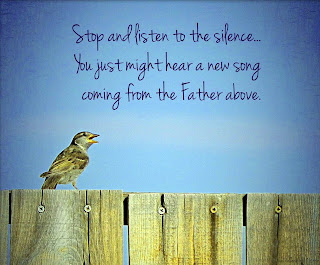 In our reading today, the prophet Habakkuk wrestled with “the problem of unanswered prayer” (vv. 1-4). God appeared to be silent. However, as we will see, the truth was simply that Habakkuk wasn’t satisfied with God’s answers to his prayer. I have often been asked what I do when God tells me to “wait.” My answer is usually very unsatisfactory. I tell folks that God never answers our prayer with “wait a while.” His answer is always a “yes” or a “no.” Sometimes we simply don’t like the answer we hear, so we try to soften it with some other explanation of the refusal of God to be our personal vending machine of blessing. This is at the heart of the meme I’ve chosen to accompany today’s devotional: Stop and listen to the silence… You might just hear a new song coming from the Father above.
Sometimes “the problem of answered prayer” can be as hard as “the problem of unanswered prayer.” God told Habakkuk he would raise up the Babylonians to punish Judah for its injustice and wickedness. But Habakkuk wondered how that could be a solution to the problems he prayed about. The Babylonians were more wicked than the people of Judah! How could God use evil to accomplish something good? Would God just replace one kind of suffering for the oppressed with another kind that was worse for everyone? That may be a question we also ask sometimes. We see evidence of sin, and we wish God would take it away. But then the problems seem to go from bad to worse. Is there no end to the suffering in this world?
Let me be very clear. God does not take pleasure in our pain, except that he knows it will ultimately bring about our great good. God has promised to use our suffering to work good in our lives (cf. Romans 8:28-39). We see the clearest example of this in the cross of Christ, where the greatest evil accomplished the greatest good. The Apostle Paul wrote, “God made him who had no sin to be sin for us, so that in him we might become the righteousness of God” (2 Corinthians 5:21). There can be no doubt that nothing about the death of Jesus seemed good; yet, the ultimate good was produced from it. Without this work of sacrifice, none of us would have any possibility of life. We would all be relegated to receive what we deserve, death! Celebrate life, even when God seems to be silent!
In our reading today, the prophet Habakkuk wrestled with “the problem of unanswered prayer” (vv. 1-4). God appeared to be silent. However, as we will see, the truth was simply that Habakkuk wasn’t satisfied with God’s answers to his prayer. I have often been asked what I do when God tells me to “wait.” My answer is usually very unsatisfactory. I tell folks that God never answers our prayer with “wait a while.” His answer is always a “yes” or a “no.” Sometimes we simply don’t like the answer we hear, so we try to soften it with some other explanation of the refusal of God to be our personal vending machine of blessing. This is at the heart of the meme I’ve chosen to accompany today’s devotional: Stop and listen to the silence… You might just hear a new song coming from the Father above.
Sometimes “the problem of answered prayer” can be as hard as “the problem of unanswered prayer.” God told Habakkuk he would raise up the Babylonians to punish Judah for its injustice and wickedness. But Habakkuk wondered how that could be a solution to the problems he prayed about. The Babylonians were more wicked than the people of Judah! How could God use evil to accomplish something good? Would God just replace one kind of suffering for the oppressed with another kind that was worse for everyone? That may be a question we also ask sometimes. We see evidence of sin, and we wish God would take it away. But then the problems seem to go from bad to worse. Is there no end to the suffering in this world?
Let me be very clear. God does not take pleasure in our pain, except that he knows it will ultimately bring about our great good. God has promised to use our suffering to work good in our lives (cf. Romans 8:28-39). We see the clearest example of this in the cross of Christ, where the greatest evil accomplished the greatest good. The Apostle Paul wrote, “God made him who had no sin to be sin for us, so that in him we might become the righteousness of God” (2 Corinthians 5:21). There can be no doubt that nothing about the death of Jesus seemed good; yet, the ultimate good was produced from it. Without this work of sacrifice, none of us would have any possibility of life. We would all be relegated to receive what we deserve, death! Celebrate life, even when God seems to be silent!

Monday, April 6, 2020
Our God, His Family
And the word of the Lord of hosts came, saying, “Thus says the Lord of hosts: I am jealous for Zion with great jealousy, and I am jealous for her with great wrath. Thus says the Lord: I have returned to Zion and will dwell in the midst of Jerusalem, and Jerusalem shall be called the faithful city, and the mountain of the Lord of hosts, the holy mountain. Thus says the Lord of hosts: Old men and old women shall again sit in the streets of Jerusalem, each with staff in hand because of great age. And the streets of the city shall be full of boys and girls playing in its streets. Thus says the Lord of hosts: If it is marvelous in the sight of the remnant of this people in those days, should it also be marvelous in my sight, declares the Lord of hosts? Thus says the Lord of hosts: Behold, I will save my people from the east country and from the west country, and I will bring them to dwell in the midst of Jerusalem. And they shall be my people, and I will be their God, in faithfulness and in righteousness.” (Zechariah 8:1-8 ESV).
 I’ve heard it said that we should love others when they least deserve it, because that’s when they need it most. Our reading today echoes this action as God declares, “They will be my people, and I will be … their God” (v. 8). This is the same covenantal language found throughout the Scripture. God spoke words like these to Abraham when he was old and childless, saying that he and his wife, Sarah, would soon have a son. To Abraham God promised, “I will … be your God and the God of your descendants after you” (Genesis 17:7). He never voided this covenant; He never denied this commitment.
The strange thing is that more often than not, the descendants of Abraham were not faithful in keeping the covenant God had made with them. God sent prophet after prophet to his people, calling them back to obedience, but they refused to forsake their ways in favor of God’s way. They simply refused to listen. Finally God sent his Son, Jesus, to the world. He was rejected more than any prophet before him. But in the death of Jesus we see the restoration of the covenant that had been broken by rebellious people.
The writer of Hebrews says, “It is not angels he helps, but Abraham’s descendants” (Hebrews 2:16). The Apostle Paul declares, “If you belong to Christ, then you are Abraham’s seed” (Galatians 3:29). This means “Jesus is not ashamed to call [us] brothers and sisters” (Hebrews 2:11). In Jesus, the promise of a city where people old and young can rest and play is fulfilled. In the New Jerusalem, each of us will hear the loud voice that John heard: “They will be his people, and God himself will be with them and be their God” (Revelation 21:3). I wonder if at least one of the things God is doing in the midst of the COVID-19 pandemic, peaking just before Easter in some places of our country, is not to call all of us back home. Use today, this Monday of Passion Week, to ponder your eternal Father!
I’ve heard it said that we should love others when they least deserve it, because that’s when they need it most. Our reading today echoes this action as God declares, “They will be my people, and I will be … their God” (v. 8). This is the same covenantal language found throughout the Scripture. God spoke words like these to Abraham when he was old and childless, saying that he and his wife, Sarah, would soon have a son. To Abraham God promised, “I will … be your God and the God of your descendants after you” (Genesis 17:7). He never voided this covenant; He never denied this commitment.
The strange thing is that more often than not, the descendants of Abraham were not faithful in keeping the covenant God had made with them. God sent prophet after prophet to his people, calling them back to obedience, but they refused to forsake their ways in favor of God’s way. They simply refused to listen. Finally God sent his Son, Jesus, to the world. He was rejected more than any prophet before him. But in the death of Jesus we see the restoration of the covenant that had been broken by rebellious people.
The writer of Hebrews says, “It is not angels he helps, but Abraham’s descendants” (Hebrews 2:16). The Apostle Paul declares, “If you belong to Christ, then you are Abraham’s seed” (Galatians 3:29). This means “Jesus is not ashamed to call [us] brothers and sisters” (Hebrews 2:11). In Jesus, the promise of a city where people old and young can rest and play is fulfilled. In the New Jerusalem, each of us will hear the loud voice that John heard: “They will be his people, and God himself will be with them and be their God” (Revelation 21:3). I wonder if at least one of the things God is doing in the midst of the COVID-19 pandemic, peaking just before Easter in some places of our country, is not to call all of us back home. Use today, this Monday of Passion Week, to ponder your eternal Father!

Sunday, April 5, 2020
A Song in My Heart
Sing aloud, O daughter of Zion; shout, O Israel! Rejoice and exult with all your heart, O daughter of Jerusalem! The Lord has taken away the judgments against you; he has cleared away your enemies. The King of Israel, the Lord, is in your midst; you shall never again fear evil. On that day it shall be said to Jerusalem: “Fear not, O Zion; let not your hands grow weak. The Lord your God is in your midst, a mighty one who will save; he will rejoice over you with gladness; he will quiet you by his love; he will exult over you with loud singing. I will gather those of you who mourn for the festival, so that you will no longer suffer reproach. Behold, at that time I will deal with all your oppressors. And I will save the lame and gather the outcast, and I will change their shame into praise and renown in all the earth. At that time I will bring you in, at the time when I gather you together; for I will make you renowned and praised among all the peoples of the earth, when I restore your fortunes before your eyes,” says the Lord. (Zephaniah 3:14-20 ESV).
 Singing has been practiced by people in virtually every culture throughout history. Have you ever wondered why the act of singing has such universal appeal? One important reason is that words that are sung can have a much greater impact on us than words that are only spoken. This is why so much of the praise we offer God is done in song. I love the quote from Augustine, who once said that “whoever sings prays twice.” It is no wonder that there is a large portion of the Old Testament devoted to the songs of worship for Israel. We know this “hymnbook” as the Psalms.
Today’s reading gives us a slightly different perspective. We see God doing the singing. We might think that the reference today showing God singing is not meant to be taken literally, but I have a feeling it is. God told Moses, “Write down this song and teach it to the Israelites and have them sing it” (Deuteronomy 31:19). Most of the following chapter contains the song God taught Moses so that the people could learn it too. The heavenly choir depicted in the book of Revelation also sings, and it draws from that old song of Moses as it sings “the song of God’s servant Moses and of the Lamb” (Revelation 15:3-4).
Today is Palm Sunday in the Christian calendar. The people of in Jerusalem for Passover lined the road when Jesus began his ride into the city. The praise was exuberant and filled with anticipation at the coming salvation they believed Jesus would bring to them. He did bring salvation, even though many did not understand the means through which He would accomplish it. He had to sacrifice his life for the debt to be paid. The great good news is that he did. It is done. This finished work now should allow us to sing! I hope that is your song! He sings for us… can you sing for Him?
Singing has been practiced by people in virtually every culture throughout history. Have you ever wondered why the act of singing has such universal appeal? One important reason is that words that are sung can have a much greater impact on us than words that are only spoken. This is why so much of the praise we offer God is done in song. I love the quote from Augustine, who once said that “whoever sings prays twice.” It is no wonder that there is a large portion of the Old Testament devoted to the songs of worship for Israel. We know this “hymnbook” as the Psalms.
Today’s reading gives us a slightly different perspective. We see God doing the singing. We might think that the reference today showing God singing is not meant to be taken literally, but I have a feeling it is. God told Moses, “Write down this song and teach it to the Israelites and have them sing it” (Deuteronomy 31:19). Most of the following chapter contains the song God taught Moses so that the people could learn it too. The heavenly choir depicted in the book of Revelation also sings, and it draws from that old song of Moses as it sings “the song of God’s servant Moses and of the Lamb” (Revelation 15:3-4).
Today is Palm Sunday in the Christian calendar. The people of in Jerusalem for Passover lined the road when Jesus began his ride into the city. The praise was exuberant and filled with anticipation at the coming salvation they believed Jesus would bring to them. He did bring salvation, even though many did not understand the means through which He would accomplish it. He had to sacrifice his life for the debt to be paid. The great good news is that he did. It is done. This finished work now should allow us to sing! I hope that is your song! He sings for us… can you sing for Him?

Saturday, April 4, 2020
The Apple of His Eye
For thus said the Lord of hosts, after his glory sent me to the nations who plundered you, for he who touches you touches the apple of his eye: “Behold, I will shake my hand over them, and they shall become plunder for those who served them. Then you will know that the Lord of hosts has sent me. Sing and rejoice, O daughter of Zion, for behold, I come and I will dwell in your midst, declares the Lord.” (Zechariah 2:8-10 ESV).
 In the original Hebrew text of Zechariah, the phrase “the apple of his eye” is more literally translated “the little man of his eye.” If you look deeply into someone’s eyes, you actually see a tiny reflection of yourself in their pupils. Our word “pupil” comes from the Latin “pupilla,” which means “little doll.” At some point in our language development, the “little man” or “little doll” became the “apple” of the eye, possibly because pupils are round. There are some interesting things about this idiom. The pupil, or the “apple of the eye” is the most sensitive part of the eye; it can be harmed by the tiniest of particles; and, is irreparable if damaged or destroyed. Have you noticed how we instinctively protect and cherish our eyes, perhaps more than any other part of our body?
As believers, we are the apple of God’s eye. Just think about that. We are God’s highest priority of His creation, made in His image. He protects us, cares for us, and cares about us. We are cherished by the God of the universe!
Especially in the season of Lent we should miss the amazing reality behind this image. Figuratively speaking, when believers look into God’s eyes, they see their own reflection because the Father is always looking at his children. The Apostle Peter says, “The eyes of the Lord are on the righteous … but the face of the Lord is against those who do evil” (1 Peter 3:12). It is true that sin turns our eyes away from God, but whenever we look back to God we are reminded of the steady gaze of his love. His attention is not broken by our failures. We can always look into his eyes and see ourselves as he continuously focuses on us. We are always “in God’s eyes.”
All this is true because of what happened on the cross. If anyone was ever the apple of God’s eye, surely it was Jesus, His only begotten Son. But he closed his eyes in death so that being the apple of God’s eye could become a reality for us forever. God turned his face away from his Son for our sake, and now the eyes of the Father are focused, because of Christ, on us. All of our difficulty, every challenging circumstance, is before Him. His promise is that He will overcome all of them with the mere “shake of his hand” (v. 9). That is our God! This season spend some time getting to know Him better than ever before!
In the original Hebrew text of Zechariah, the phrase “the apple of his eye” is more literally translated “the little man of his eye.” If you look deeply into someone’s eyes, you actually see a tiny reflection of yourself in their pupils. Our word “pupil” comes from the Latin “pupilla,” which means “little doll.” At some point in our language development, the “little man” or “little doll” became the “apple” of the eye, possibly because pupils are round. There are some interesting things about this idiom. The pupil, or the “apple of the eye” is the most sensitive part of the eye; it can be harmed by the tiniest of particles; and, is irreparable if damaged or destroyed. Have you noticed how we instinctively protect and cherish our eyes, perhaps more than any other part of our body?
As believers, we are the apple of God’s eye. Just think about that. We are God’s highest priority of His creation, made in His image. He protects us, cares for us, and cares about us. We are cherished by the God of the universe!
Especially in the season of Lent we should miss the amazing reality behind this image. Figuratively speaking, when believers look into God’s eyes, they see their own reflection because the Father is always looking at his children. The Apostle Peter says, “The eyes of the Lord are on the righteous … but the face of the Lord is against those who do evil” (1 Peter 3:12). It is true that sin turns our eyes away from God, but whenever we look back to God we are reminded of the steady gaze of his love. His attention is not broken by our failures. We can always look into his eyes and see ourselves as he continuously focuses on us. We are always “in God’s eyes.”
All this is true because of what happened on the cross. If anyone was ever the apple of God’s eye, surely it was Jesus, His only begotten Son. But he closed his eyes in death so that being the apple of God’s eye could become a reality for us forever. God turned his face away from his Son for our sake, and now the eyes of the Father are focused, because of Christ, on us. All of our difficulty, every challenging circumstance, is before Him. His promise is that He will overcome all of them with the mere “shake of his hand” (v. 9). That is our God! This season spend some time getting to know Him better than ever before!

Friday, April 3, 2020
A Slower Pace
The next day again John was standing with two of his disciples, and he looked at Jesus as he walked by and said, “Behold, the Lamb of God!” The two disciples heard him say this, and they followed Jesus. Jesus turned and saw them following and said to them, “What are you seeking?” And they said to him, “Rabbi” (which means Teacher), “where are you staying?” He said to them, “Come and you will see.” So they came and saw where he was staying, and they stayed with him that day, for it was about the tenth hour. (John 1:35-39 ESV).
The first line of the Washington Post article read: “It took a global pandemic to slow us down.” The author of the article went on to write a wonderful description of her new normal. Erin O’Connor said:
The boys’ first spring baseball tournament was canceled and our daughter’s state gymnastic meet was scrapped. Instead, we watched “The Sound of Music” and ate chips on the living room couch. The children’s schools are closed, and we are lucky enough to have jobs that allow us to predominantly work from home. Rather than driving the children to and from extracurricular activities in the evenings, we now review essays and math problems we assigned them earlier in the day. We eat dinner together on a daily basis, instead of devouring to-go meals in the minivan. We take evening family walks to relieve restlessness. My husband and I enjoy watching our kids, ages 13, 11, 9 and 9, run outside and play with one another. While I’m not going to say there haven’t been arguments, our children have been forced to appreciate the companionship their siblings provide.
 It isn’t that hard for me to remember both the slower pace of decades ago and the slower pace of my present. The great difference is that I somehow feel guilty for going slowly now. I’m certain that was not the case in the late 50’s and early 60’s when I was an older adolescent. I remember one particular experience of those times when I wanted to go see my grandmother. She lived across the island from us. It was just a short trip by car, but both longer and much more dangerous for a ten year old riding his bicycle. I made the trip weaving in and out of the sparse traffic of those days and arrived just a bit before lunch. Grandma always had something cooking. This day I was greeted with eggplant parmesan and spaghetti with meat sauce. Grandma Emmitte never cooked a little, and it was always made from scratch. Her pasta was phenomenal! I ate my fill finishing just about the time my Dad walked in. It seems she had called him and said, “Frankie (only called that by his mother), your boy rode his bike to the house again.” That’s how it always ended; but, it was always worth it!
It was always worth it because I got to spend some time with my grandma and have a great meal! He broken English mixed with Italian was always harder to understand than her gestures of love and acceptance. That’s how the pace was. Perhaps this season of Lent, in the midst of this crisis, you will see it as a good time to slow down and spend some time with both your family and “the Lamb of God, who takes away the sin of the world” (John 1:29). It will be worth it! The first disciples spent the day with Jesus… they were never the same!
It isn’t that hard for me to remember both the slower pace of decades ago and the slower pace of my present. The great difference is that I somehow feel guilty for going slowly now. I’m certain that was not the case in the late 50’s and early 60’s when I was an older adolescent. I remember one particular experience of those times when I wanted to go see my grandmother. She lived across the island from us. It was just a short trip by car, but both longer and much more dangerous for a ten year old riding his bicycle. I made the trip weaving in and out of the sparse traffic of those days and arrived just a bit before lunch. Grandma always had something cooking. This day I was greeted with eggplant parmesan and spaghetti with meat sauce. Grandma Emmitte never cooked a little, and it was always made from scratch. Her pasta was phenomenal! I ate my fill finishing just about the time my Dad walked in. It seems she had called him and said, “Frankie (only called that by his mother), your boy rode his bike to the house again.” That’s how it always ended; but, it was always worth it!
It was always worth it because I got to spend some time with my grandma and have a great meal! He broken English mixed with Italian was always harder to understand than her gestures of love and acceptance. That’s how the pace was. Perhaps this season of Lent, in the midst of this crisis, you will see it as a good time to slow down and spend some time with both your family and “the Lamb of God, who takes away the sin of the world” (John 1:29). It will be worth it! The first disciples spent the day with Jesus… they were never the same!

Subscribe to:
Posts (Atom)
